
MAY HIS SOUL REST IN PEACE, AND MAY PERPETUAL LIGHT SHINE UPON HIM.
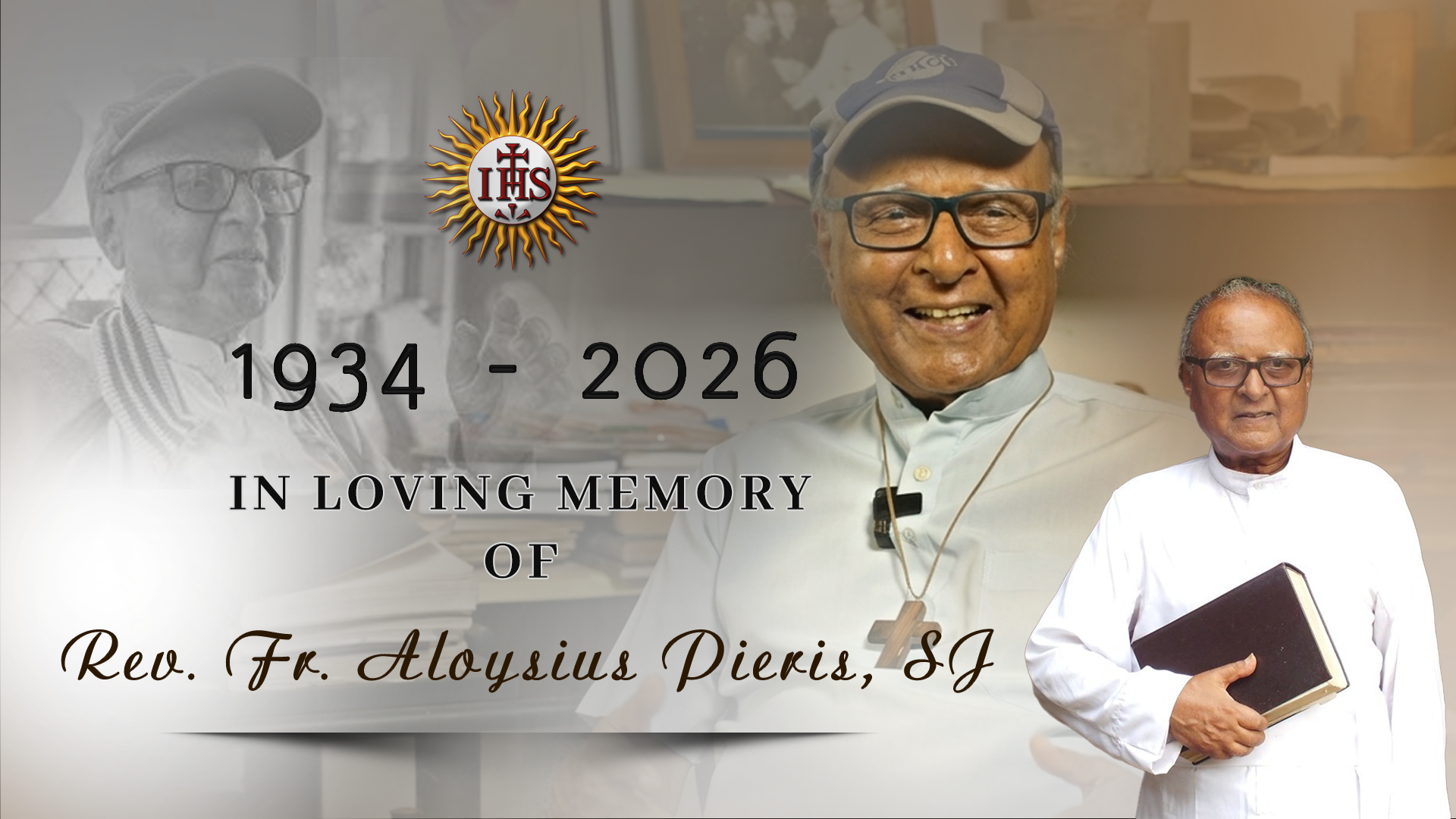
Rev. Fr. Aloysius Pieris SJ: An Asian Insight in Liberation Theology
Aloysius Pieris was born on April 9, 1934, as the tenth child in a family of twelve. He grew up in the village of Ampitiya in Kandy. He received his primary education at St. Mary’s College, Ampitiya, and St. Aloysius College, Galle. His early Christian thinking was shaped by the unique environment of the Ampitiya Seminary (then the Papal Seminary), surrounded by a strong Buddhist cultural context.
Early Formation for Priesthood
From a young age, he felt a desire to become a priest. At the age of 12, he wanted to learn Latin and was assisted by a Jesuit priest at the Ampitiya Seminary. Within just two years, he was able to read the New Testament and The Imitation of Christ in Latin.
His father, though an English school principal, was a patriot with a deep love for native languages and national independence. While he did not fully approve of his son’s path, he did not hinder his education. Instead, he arranged for him to learn Pali through a learned monk. By the age of 14, when he entered the minor seminary in Galle, Aloysius was already proficient in both Latin and Pali. His journey was further supported by Fr. Perniola SJ, a Pali scholar and rector of St. Aloysius College.
In 1953, after passing the London Advanced Level examination, he went to India and joined the Society of Jesus. There, he obtained a degree in philosophy (L.Ph) and studied Sanskrit under a Brahmin scholar through the medium of Sanskrit itself. Returning to Sri Lanka, he earned a BA in Pali and Sanskrit, served as a hostel warden, and taught mathematics and Pali at St. Aloysius College for a year.
Theological Studies and Ministry
Later, he went to Naples, Italy, to study theology at the Pontifical Theological Faculty under the Jesuits during the time of the Second Vatican Council. This period profoundly influenced him. While in Italy, he served as a spiritual director for a youth organization, ministered to hospital patients, and worked among the poor in slums.
He also engaged deeply in liturgical studies and received special training in this field. He earned a diploma in music and studied Sacred Scripture in Hebrew under the renowned scholar Stephan Porubčan. Despite occasional challenges, his superiors supported and encouraged him.
Return to Sri Lanka and Mission
eturning to Sri Lanka with the spirit of Vatican II and new theological insights, Fr. Pieris pursued a PhD in Buddhism under Ven. Rahula. At the same time, he worked among the urban poor in Dematagoda. His engagement with medical students, university students, and marginalized communities sharpened his theological vision.
He also initiated youth activities, including the founding of Cineforum, a film discussion group that critically engaged with cinema weekly.
Founding of Tulana Research Centre
n 1974, he founded the Tulana Research Centre, which became a leading institution in Sri Lanka for interreligious dialogue and liberation theology. It gained international recognition and attracted scholars from around the world.
Tulana is not merely a research center but a rich artistic space expressing liberation spirituality through sculptures, paintings, and art—many contributed by Buddhist monks. One notable sculpture commemorates those who disappeared during Sri Lanka’s conflicts.
The center also houses an outstanding library and a media unit that has guided many young people in film, radio, drama, and the arts. Additionally, under his guidance, a special education center for hearing- and speech-impaired children was established in Kelaniya.
A Builder of Bridges
Fr. Pieris was a bridge-builder between Buddhism and Christianity at both intellectual and grassroots levels. Through interreligious and intra-church dialogue, he connected people across divisions in Sri Lanka and internationally.
He played a crucial role in promoting liberation theology and Asian theology among clergy, religious, and laity of all generations. During times when progressive thinkers faced opposition, he stood firmly with them, offering support and advocacy.
A Global Scholar and Sage
Fr. Aloysius Pieris is considered one of Sri Lanka’s greatest theologians and a leading global theological thinker of recent times. Despite his intellectual brilliance, he lived a simple and humble life, almost like a monk, at Tulana.
He once said:
“Christian identity is not merely simplicity or acts of charity. Many religions practice these. But a Christian goes further—joining the struggle of the poor to liberate them. That is true Christian identity.”
A Living Legacy
He authored over 30 major works, presented more than 500 research papers, and wrote thousands of articles. He served as editor of several theological journals and lectured at many prestigious universities worldwide.
The Spirit of Aloysius
While his academic achievements and knowledge of Buddhism are widely admired, what truly earns him respect is his lived wisdom. He was not just an intellectual but a transformative thinker who integrated knowledge with action to challenge unjust social structures.
His legacy is not to be preserved merely in memory or admiration but to be lived—by continuing the struggle for justice and liberation that he embodied.
Biographical Summary
• Full Name: Marian Reginald Aloysius Pieris
• Date of Birth: April 9, 1934
• Place of Birth: Ampitiya, Kandy
• Father: Walter John Pieris (Principal of Ampitiya English School)
• Mother: Dona Anselmina
Key Achievements
• Learned Latin at age 12; Pali simultaneously
• Entered minor seminary at 14
• Joined Jesuits in 1953
• Degrees in Philosophy, Pali, Sanskrit, Theology
• PhD in Buddhist Studies (first non-Buddhist in Sri Lanka to receive it)
• Diploma in Music (Venice, 1964)
• Ordained priest in Rome (1965)
• Honorary Doctorate (Tilburg University, 1987)
• Lecturer at Cambridge, Oxford, London, Gregorian (Rome), and many others
• Long-time lecturer at EAPI, Manila
• Active member of EATWOT
• Editor of Concilium and Dialogue
Major Works
• An Asian Theology of Liberation (1988)
• Love Meets Wisdom (1988)
• Fire and Water (1996)
• God’s Reign for God’s Poor (1999)
• Mysticism of Service (2000)
• Christhood of Jesus and the Discipleship of Mary (2002)
• Prophetic Humor in Buddhism and Christianity (2004)
• Sinhala work: Jesus of Nazareth and Jesus of India
Final Note
Beyond all academic accomplishments, his greatest contribution was founding the Tulana Research Centre on June 7, 1974—a landmark in his life and a lasting gift to humanity.
Rev. Fr. Aloysius Pieris remains a light whose vision calls us to live out liberation in action.